Experiment Operations During Apollo EVAs
Experiment: Solar Wind Composition
Acronym: SWC
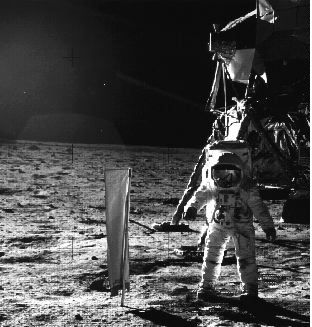
The SWC foil deployed on Apollo 11. Notice the identification of which
side should be in the shade at the bottom of the foil (AS-11-40-5873).

The SWC foil on Apollo 16 had some sections of platinum, which allowed
for easier cleaning operations on Earth. Note the identity of the sun side
near the bottom (AS-16-117-18849).
PI/Engineer: J. Geiss, Univ. of Bern
Other Contacts:
P. Signer, F. Buehler, J. Meister, P. Eberhardt
Apollo Flight Nos.: 11, 12, 14, 15, & 16
Apollo Exp't No.: S 080
Discipline: solar wind, solar physics
Weight: Total 430 g (foil 130 g); 450 g on A-16
Dimensions: Foil Sheet: 30 cm x 140 cm (130 cm exposed, 15 microns
thick)
Pole: 4 cm diameter 40 cm long, stowed (1.5 m long, deployed)
Manufacturer: University of Bern, Swiss Nat'l Science Foundation
Description/Purpose:
The SWC experiment consisted of an aluminum metal foil which was deployed
to trap the solar wind so as to measure the ion types and energies of the
solar wind on the lunar surface. The area of the foil was 4000 cm2. It
was deployed on a five-section telescopic pole and unrolled. The reel of
foil was stored inside the collapsed pole. Purity of the foil was critical
to avoid contamination of the lunar samples and background contamination
of the experiment itself. The A-16 experiment was composed of both aluminum
and platinum foils. The platinum foil allowed for treatment with dilute
hydrofluoric acid before sample analysis on Earth to remove dust contamination
and the resulting uncertainties.
Unloading from the LM: No comments by crew.
Transporting by foot or MET: Hand carried.
Loading/unloading tools/exp'ts on LRV: NA
Site selection: Near the LM, in the sun.
Deploying experiment:
The telescopic pole was extended and the five sections locked automatically.
The reel was then pulled out, and the foil was unrolled and fastened to
a hook near the lower end of the pole. The pole was pressed upright into
the ground, but it did not necessarily have to be perfectly vertical. Pictures
from A-12 clearly show it leaning ~10 degrees, perhaps to provide more
area perpendicular to the sun. Pictures from A-14, 15, and 16 show it to
be within a few degrees of vertical. On A-11, it was possible to penetrate
the lunar surface only ~4 or 5 inches with the pole. One side of the foil
was marked with the word SUN, which was pointed at the sun. A typical timeline
from A-15 shows ~7 minutes for deploying the experiment.
Check-out of experiment: None required.
Operation of experiment:
Exposed for 77 minutes on A-11, 18 h, 42 minutes on A-12, 21 hours
on A-14, 41 hours , 8 minutes on A-15, and 45 h, 5 minutes on A-16.
Repairs to experiment: See recovery/take
down.
Recovery/take-down of experiment:
The reel was spring-loaded to facilitate rewinding of the foil. It
was detached from the telescopic pole, placed in a teflon bag, and placed
in a sample return container. The pole was not returned. A typical timeline
from A-15 shows ~4 minutes for retrieving the foil and placing it in the
bag.
On A-12, the foil rolled up the first ~1.5 ft. After that, it
would crinkle rather than roll. Using great care, they tried to roll up
the foil, but on the 5th attempt a crack appeared in the crinkle area.
They finally used their hands to roll it, and as a result the foil was
soiled by the dirt adhering to their gloves. After it was rolled, they
discovered that it was too big to fit into the container that was to be
used to return it, and had to crush it with their hands. Upon inspection
during the EVA 2 they decided that the foil tended to "set" and that it
would not roll up because the set was stronger than the tension of the
roller.
On A-14, about half the foil rolled up automatically, the rest
was done manually. On A-15, the foil was rolled manually when it failed
to roll mechanically. There was no reported difficulty recovering the A-16
foil.
Stowing experiment for return:
Placed in a Teflon bag, then into the sample return container. On A-15,
it was transferred to the LM via the equipment transfer bag (still in its
Telfon bag) and may have been kept separate from other samples to minimize
dust contamination.
Loading/unloading samples on LRV: NA
Loading of exp't/samples into the LM: With
the sample return container.
Stowing of package once in the LM: With the sample return container.
Sampling operations - soil, rocks:
The foil had to be ultrasonically cleaned before analysis on Earth.
Part of the sheet was then melted in an ultra-high vacuum system and the
gasses released were analyzed with a mass spectrometer. The platinum portions
of the A-16 foil were cleaned with aqueous HF before analysis.
Trenching: NA
Raking: NA
Drilling:
Emplacing the shaft into the ground by hammering was difficult due
to the compacted nature of the subsurface.
Navigating/recognizing landmarks: NA
Were there any hazards in the experiment?
i.e. hazardous materials (explosive, radioactive, toxic), sharp
objects, high voltages, massive, bulky, tripping hazards, temperatures?:
No.
Was lighting a problem?: No.
Were the results visible to the crew?: No.
Would you recommend any design changes?:
No comments by crew. The foil was changed for A-16 to include a platinum
section to determine whether HF acid could be used to remove any dust from
the surface before analysis.
Were any special tools required?:
A hammer was sometimes required to drive the shaft into the ground.
Was the orientation of the experiment (i.e. horizontal/vertical)
important? Difficult?
The metal foil needed to be oriented perpendicular to the sun so as
to capture the solar wind most efficiently. On A-14, 15, and 16 the reel
handle was color coded to give the exact angular position during exposure
of the reel and the portion of the foil rolled around it to yield the angular
distribution of the arriving solar wind.
Was the experiment successful?: Yes.
Were there related experiments on other flights?:
Yes. Some satellite measurements of solar wind and plasma and magnetic
field strengths are relevant, i.e. Explorer 35, Vela 3A and 3B See also
S
035 - Solar Wind Spectrometer. On A-17, there was a greatly scaled
down version of the Al and Pt foils included as part of the Lunar
Surface Cosmic Ray Experiment (LSCRE). Also, the lunar regolith itself
has trapped the solar wind over the eons, but is an uncertain "instrument."
Still, analysis of volatiles released upon heating of the regolith is used
to provide insight into the solar wind.
Where was it stored during flight?: LM MESA (Modularized Equipment
Stowage Assembly) in Quad IV.
Were there any problems photographing the experiment?: No.
What pre-launch and cruise req'ts were there? power, thermal,
late access, early recovery?:
None.
What was different between training and actual EVA?: No comments
by crew.
What problems were due to the suit rather than the experiment?:
No comments by crew.
Any experiences inside the LM of interest from the experiment/operations
viewpoint?:
No comments by crew.
References:
Preliminary Science Reports for A-11, 12, 14, 15, & 16
Mission Reports for A-11, 12, 14, 15, 16
Apollo Scientific Experiments Data Handbook, JSC-09166, NASA TM
X-58131, August, 1974, In JSC History Office.
Final Apollo 11 Lunar Surface Operations Plan, JSC, June 27, 1969
Apollo Program Summary Report, section 3.2.22 Solar Wind Composition
Experiment, JCS-09423, April, 1975.
Apollo Program Summary Report, section 3.2.29 Particle Implantation
Studies, JCS-09423, April, 1975.