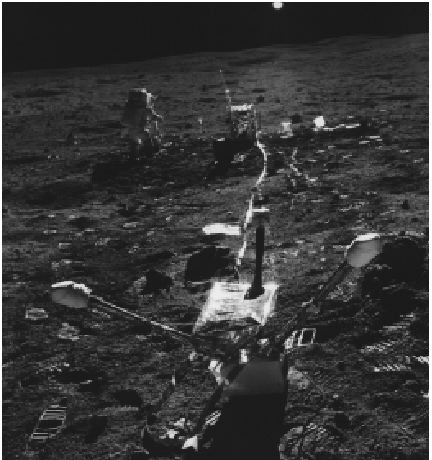
The LSM deployed at the Apollo 16 ALSEP site.(AS-16-113-18373).
The LSM deployed at the Apollo 16 ALSEP site.(AS-16-113-18373).
PI/Engineer: Palmer Dyal, Ames Research Center
Other Contacts: Charles P. Sonett, Lunar & Planetary Lab/U
of AZ
Apollo Flight Nos.: 12, 15, 16
Apollo Exp't No.: S 034
Discipline: lunar magnetometry
Weight: 8.6 kg
Dimensions: 25 x 28 x 63 cm, stowed
Manufacturer: Naval Ordinance Lab, NASA Ames Research Center, Philco - Ford
Description/Purpose:
The purpose of the magnetometer was to measure the magnetic field on
the lunar surface and to determine from these measurements some of the
deep-interior electrical properties of the Moon. This experiment also helped
to elucidate the interaction between the solar plasma and the lunar surface.
The Earth's magnetic field also extends to the Moon's orbit. Thus, as the
Moon passed through the "bow shock" of the Earth it was detected by the
LSM.
Unloading from the LM: As part of the ALSEP pallet.
Transporting by foot or MET: As part of the ALSEP.
Loading/unloading tools/exp'ts on LRV: NA
Site selection:
As part of the ALSEP, 12.2 to 14.6 m NW
of the central station, limited by a 15.2 m cable, to minimize the EMI
effect on the sensors. Also a minimum of 24 m from the CCGE, which contained
a strong magnet. The instrument could measure its position with respect
to the lunar coordinate system. This is accomplished by the use of level
sensor readings of two angles and a shadowgraph reading taken by an astronaut
to determine the azimuthal alignment of the magnetometer. Large metallic
bodies nearby would compromise the measurements.
Deploying experiment:
The experiment was transported in a folded configuration. Once deployed,
each "arm" was directed at an angle of ~35 degrees above the horizontal,
each being orthogonal to the other two. The CDR released the unit with
the UHT, then removed and discarded a support bracket. He then grasped
a lift-off handle to lift it off the sub-pallet and carried it by hand
~3 meters. After repositioning the unit to the vertical position he placed
it on the surface with the carry handle upright.. The LMP then took the
LSM to the deployment site. He discarded a bracket, deployed 3 support
legs, rotated the unit so that a color-coded leg was oriented eastward,
and put it on the surface. The UHT was used to remove and discard foam
packing, and to extend the 3 arms. A lanyard was used to remove a cover.
It was checked for any packing materials and pieces and to ensure the thermal
doors were open. It was azimuthally aligned along the ALSEP-to-sun line
by moving the instrument around until shadowgraph reading, as transmitted
over the voice telemetry link, indicated that it was within 0.5 degree
of the instrument shadowgraph-to-sun line. It was leveled with the UHT
by observing a bubble level. A typical timeline from A-15 shows ~15 minutes
for deploying the experiment. A-16 allotted 9 minutes. Two orthogonal level
sensors indicated that the instrument changed its orientation by ~2 degrees
during the first lunar day during one of the missions. None of the mission
reports mentioned any difficulty in deployment.
Check-out of experiment: From Earth.
Operation of experiment: From JSC via the ALSEP command system.
Repairs to experiment:
None required on EVA. The measurement ranges were halved from the A-12
instrument values for the later instruments. A curtain was also added over
the electronics box to improve thermal control.
Recovery/take-down of experiment: NA
Stowing experiment for return: NA
Loading/unloading samples on LRV: NA
Loading of exp't/samples into the LM: NA
Stowing of package once in the LM: NA
Sampling operations - soil, rocks: NA
Navigating/recognizing landmarks: NA
Were there any hazards in the experiment?
i.e. hazardous materials (explosive, radioactive, toxic), sharp
objects, high voltages, massive, bulky, tripping hazards, temperatures?
No.
Was lighting a problem? No.
Were the results visible to the crew? Only the level and shadowgraph.
Would you recommend any design changes? No comments by crew.
Were any special tools required? UHT.
Was the orientation of the experiment (i.e. horizontal/vertical)
important? Difficult?
The astronaut aligned it to within 30 degrees of the sun line and could
read a shadowgraph to within 1 degree. He also leveled it to within 3 degrees
using a bubble level. It was not difficult.
Was the experiment successful?
Yes, alone and in combination with the other magneto-meter readings
at other landing sites.
Were there related experiments on other flights?
Luna 2 & 10 and Explorer 35 made orbital measurements of the Moon's
magnetic field. There was also a portable magnetometer
(S 198) on A-14 & 16 and a magnetometer on the A-15 & 16 subsatellite
(S 174) that was launched from the SM before TEI.
Where was it stored during flight?
In the Scientific Equipment Bay of the LM as part of the ALSEP package.
Were there any problems photographing the experiment? No
What pre-launch and cruise req'ts were there?
power, thermal, late access, early recovery?
What was different between training and actual EVA? No comments by crew.
What problems were due to the suit rather than the experiment? No comments by crew.
Any experiences inside the LM of interest from the experiment/operations viewpoint?: No comments by crew.
References:
Instrument description and theory in A-12 Preliminary Science Report.
Mission Reports for A-12, 14, 15, 16, 17
Apollo Scientific Experiments Data Handbook, JSC-09166, NASA TM X-58131, August, 1974, In JSC History Office.
Final Apollo 12 Lunar Surface Operations Plans, JSC, October 23, 1969
Apollo Program Summary Report, section 3.2.12 Lunar Surface Magnetometer Experi-ment, JCS-09423, April, 1975.
ALSEP Termination Report, NASA Reference Publication 1036, April, 1979.