Experiment Operations During Apollo EVAs
Experiment: Cold Cathode Gauge
(a.k.a. Cold Cathode Ion Gauge, Cold Cathode Gauge Experiment, Lunar Atmosphere
Detector)
Acronym: CCG (CCIG, CCGE)
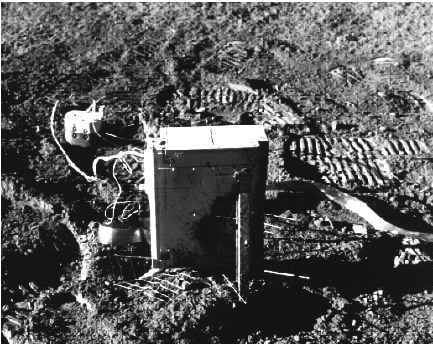
The CCG is the small unit in the background to the left of the SIDE
at the Apollo 14 ALSEP site. The cable is less stiff than the one flown
on Apollo 12. Note the lunar dust adhering to the vertical surface of the
SIDE due to its being tipped over during deployment (AS-14-67-9369). The
main ribbon cable to the central station is visible to the right.
PI/Engineer: Francis S. Johnson, Univ. of Texas at Dallas
Other Contacts:
Dallas E. Evans/JSC
J. M. Carroll/UT-Dallas
Apollo Flight Nos.: 12, 14, 15
Apollo Exp't No. S 058
Discipline: lunar atmosphere
Weight: 5.7 kg
Dimensions: 34.0 x 11.7 x 30.5 cm
Manufacturer: The Norton Co., Time Zero Corp.
Description/Purpose:
The purpose of the instrument is to measure the tenuous lunar atmosphere.
Only the amount of gas can be measured with this unit, not its composition.
Pressures between 10-6 and 10-12 could be measured. The basic sensing unit
consists of a coaxial electrode arrangement. As gas is ionized in the instrument,
the resulting current is a measure of the gas density in the gauge. The
gauge was sealed for deployment, and opened by a squib charge.
Unloading from the LM: As part of the SIDE
which is part of the ALSEP.
Transporting by foot or MET: As part of ALSEP
Loading/unloading tools/exp'ts on LRV: NA
Site selection:
As part of ALSEP and near the SIDE, to which it was attached by a 1.5
m cable. It was deployed away from the ground screen of the SIDE. It had
a strong magnet, and thus needed to be place at least 25 meters away from
the LSM.
Deploying experiment:
Some of the electronics for the CCIG were contained in the SIDE, which
provided the command and data-handling systems. It was stored in the SIDE
for transport. The CCIG was then separated from the SIDE and connected
to it by a cable ~1.5 meter long. It was intended that the gauge opening
would be oriented horizontally and would face the pole, generally away
from the LM. See the SIDE experiment for deployment details. A typical
timeline from A-15 shows ~10 minutes for deploying the SIDE, including
the CCG.
On A-12, the gauge tended to undeploy itself, but they finally
got it to lie down while pointing upward at ~ 60deg. The problem was caused
by the cable, which was cold and stiff and which kept pulling back on the
instrument and causing it to face in a generally upward direction. The
mission report stated that the tape wrap would be eliminated from future
experiment packages to avoid this problem. On A-14, considerable difficulty
was experienced with the stiffness of the interconnecting cable between
the CCIG and the SIDE. Whenever an attempt was made to move the CCIG, the
cable cause the SIDE to tip over. After several minutes of readjusting
the exp'ts, they managed to deploy them successfully.
On A-15, the connection to the SIDE was redesigned to be an "extended
leg" base on the above experience. It sat ~33 cm from the SIDE.
Check-out of experiment:
Calibration cycles were included in the instrument operation.
Operation of experiment:
Operated from JSC via the ALSEP command system. There was some confusion
during the early operation of the A-14 CCG until the correct range setting
was decided upon.
Repairs to experiment:
On A-12 the crew needed to rework the cable to get it to deploy properly.
Recovery/take-down of experiment: NA
Stowing experiment for return: NA
Loading/unloading samples on LRV: NA
Loading of exp't/samples into the LM: NA
Stowing of package once in the LM: NA
Sampling operations - soil, rocks: NA
Trenching: NA
Raking: NA
Drilling: NA
Navigating/recognizing landmarks: NA
Were there any hazards in the experiment?
i.e. hazardous materials (explosive, radioactive, toxic), sharp
objects, high voltages, massive, bulky, tripping hazards, temperatures?
A squib was used to remove the dust cover. High voltage was not turned
on until after the unit was deployed. There was a strong magnet that would
have interfered with the LSM if it was not at least 25 meters away from
it.
Was lighting a problem? NA.
Were the results visible to the crew? NA
Would you recommend any design changes?
After A-12, the Mylar tape wrap was eliminated, reducing the cable
stiffness by 70 percent. The connection to the SIDE was redesigned to be
an "extended leg" for A-15 because of the high latitude of the site - it
needed to point at the zenith. Also, the original design was for the CCG
to be totally included in the SIDE package, but its magnetic field interfered
with the SIDE instrument and the two packages needed to be separated.
Were any special tools required? No.
Was the orientation of the experiment (i.e. horizontal/vertical)
important? Difficult?
See deploying, above. It was desirable that the orifice be pointed
in a particular direction. Different missions looked in different directions
so that, as a network, greater understanding of the lunar atmosphere was
obtained. It was to have a clear view away from all other ALSEP subsystems
and the LM. An arrow decal placed on the unit was to point north.
Was the experiment successful?
Yes, but the unit at the A-12 site failed after ~14 h of operation
when the 4500 V power supply shut off. This may have been due to dust getting
into the unit when it continually tipped over during deployment.
Were there related experiments on other flights?
The LACE experiment (S 205) was an improved
atmospheric detector (mass spectrometer) developed later in the program.
There was also a mass spectrometer in the SIM Bay of A-15 &16 to measure
the atmosphere at higher altitudes.
Where was it stored during flight? In the SIDE, as part of the
ALSEP.
Were there any problems photographing the experiment? No
What pre-launch and cruise req'ts were there?
power, thermal, late access, early recovery?
What was different between training and actual EVA? No comments
by crew.
What problems were due to the suit rather than the experiment?
No comments by crew.
Any experiences inside the LM of interest from the experiment/operations
viewpoint?
Venting of the LM for EVA, and even approach of an astronaut, could
be measured due to the gasses released. Exhaust gasses from liftoff could
be detected.
References:
Preliminary Science Reports for Apollo 12, 14, 15
Personal conversation with Dallas Evans/JSC, 25 March 1993
"Alignment, Leveling, and Deployment Constraints for A-15 Lunar Scientific
Experiments", In JSC History Office
Apollo Scientific Experiments Data Handbook, JSC-09166, NASA TM X-58131,
August, 1974, In JSC History Office.
Final Apollo 12 Lunar Surface Operations Plan, JSC, October 23, 1969
Apollo Program Summary Report, section 3.2.23 Suprathermal Ion Detector
and Cold-Cathode Gage Experiments, JCS-09423, April, 1975.
ALSEP Termination Report, NASA Reference Publication 1036, April, 1979.